.png)

23 Aug 2026


Many businesses claim to provide excellent service, high quality, dependable delivery, professional support, and customer satisfaction.
Customers expect companies to speak positively about themselves.
The more important question is:
What evidence supports the promise?
A potential customer may be interested in your offer but remain uncertain about:
This is where customer proof becomes valuable.
However, not every testimonial is equally useful.
Statements such as:
Excellent service.
Highly recommended.
Great company.
May be genuine, but they give the next customer very little information.
Strong customer testimonials that convert are specific. They help buyers understand the customer’s situation, the problem, the experience, and the reason the business was worth choosing.
Testimonials should not be treated as decoration.
They should be part of a wider proof system that supports positioning, marketing, sales, delivery, and customer trust.
A company can claim to be:
But customers need evidence before trusting those claims.
Proof may come from:
The evidence makes the promise easier to believe.
Customers may worry about losing:
A relevant customer story helps them see that someone with a similar requirement made the decision and received a satisfactory experience.
A testimonial can explain aspects of the service that formal website copy may not communicate naturally.
For example:
The team did not begin with advertising. They first clarified our customer, offer, and enquiry process. That helped us understand why earlier marketing efforts were not producing suitable leads.
This testimonial communicates the business’s approach more effectively than a generic claim about strategy.
Customers do not evaluate price only through the final number.
They evaluate:
Evidence showing organised delivery and customer value can make the price easier to understand.
Proof does not justify every price. It helps customers evaluate what they are paying for.
These formats serve different purposes.
A review is usually a customer’s independent evaluation of their experience.
It may appear on:
Reviews support public reputation and discovery.
A testimonial is an approved customer statement selected and presented by the business.
It may appear on:
Testimonials should remain accurate and should not be edited in a way that changes the customer’s meaning.
A case study provides a fuller explanation of:
Case studies are useful for higher-value, complex, technical, or longer buying decisions.
Customer proof can also include:
Different customers need different proof.
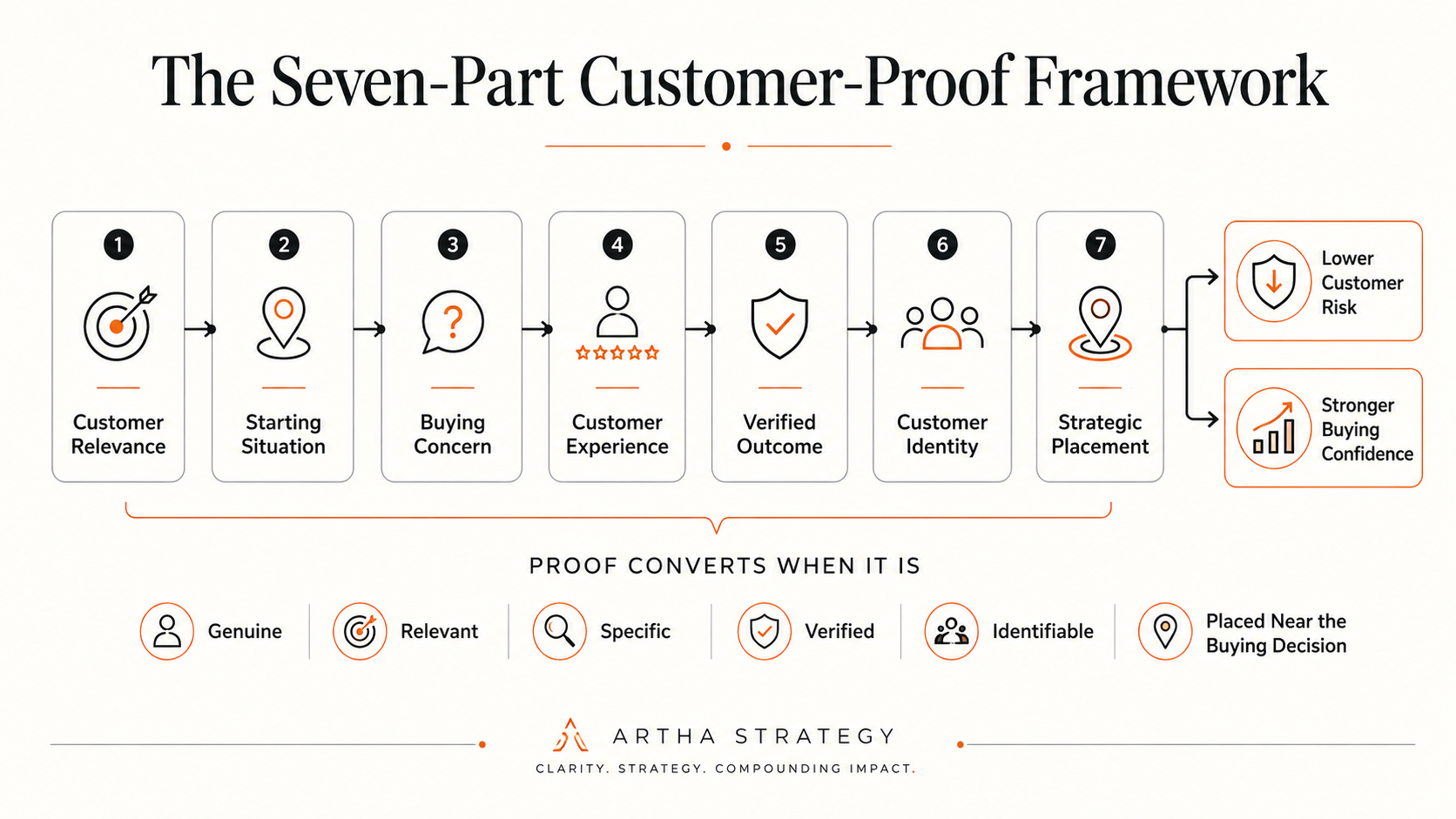
Use seven elements to create proof that helps customers make decisions.
The person reading the proof should recognise a similar customer, industry, requirement, or situation.
A clinic owner may find another clinic’s experience more relevant than a general retail example.
A manufacturer may want proof related to:
Organise testimonials by customer type where possible.
Explain what the customer needed before buying.
Examples include:
The starting situation gives context to the testimonial.
Strong proof addresses the uncertainty the next customer may also have.
Concerns may include:
A useful testimonial might say:
We were concerned that the project would require too much of our internal time, but the team provided a clear information checklist and one accountable point of contact.
This reduces a specific buying concern.
Ask the customer what it was like to work with the business.
Useful areas include:
Customer experience often provides more credible differentiation than broad marketing claims.
Where possible, include a real result.
The outcome may be:
Only use numbers that can be verified.
Never invent revenue, growth percentages, time savings, customer names, or performance data.
Use:
[ADD VERIFIED EXAMPLE]
or:
[VERIFY BEFORE PUBLISHING]
where proof still needs confirmation.
A testimonial is usually stronger when readers can understand who provided it.
Depending on permission and context, include:
Some customers may require anonymity.
In that case, use an accurate description such as:
Founder, Pune-based furniture manufacturer
Do not invent identities or imply permission that was not given.
Proof must appear where the customer needs reassurance.
Place relevant evidence near:
Do not hide every testimonial on one separate page that customers may never visit.
Request feedback after the customer has experienced meaningful value.
Suitable moments may include:
Do not wait so long that the details are forgotten.
Avoid asking only:
Can you give us a testimonial?
Customers may not know what to write.
Use questions such as:
The customer can answer in writing, voice, video, or a short interview.
Offer a suitable method:
Do not ask every customer to produce a polished paragraph.
The business may organise the response into a readable testimonial, but the customer should approve the final version.
Clarify where the proof may be used.
For example:
Permission should be appropriately recorded.
For sensitive industries or confidential work, stronger review and consent processes may be required.
You may correct obvious grammar or shorten a testimonial with permission.
Do not change the meaning, exaggerate the outcome, or make the customer sound more enthusiastic than they were.
Hello [Name]. Thank you for choosing [Business Name]. We are reviewing our customer experience and would value your honest feedback.
Could you briefly share:
With your approval, we may use your feedback on our website or business materials. We will share the final wording with you before publication.
Keep the message proportional to the customer relationship.
Gather:
Obtain permission before using private communications publicly.
Classify the feedback.
Possible themes include:
This helps you place the proof correctly.
A testimonial becomes stronger when readers understand:
Send the organised testimonial back to the customer.
Ask them to approve:
Create a central document or folder containing:
This prevents teams from repeatedly searching old WhatsApp conversations.
Use broad proof that supports the main business position.
Use testimonials from customers who purchased that specific service.
Show proof related to product quality, fit, delivery, or usage.
Use evidence that supports founder credibility, values, or working style.
Include proof relevant to the customer’s industry, problem, or buying concern.
Use short customer examples to explain process and suitability.
Turn testimonials into:
Avoid publishing a quotation without enough context.
Share a relevant example when it genuinely helps answer a concern.
Do not send a large collection of unrelated testimonials.
Suitable proof may focus on:
Healthcare testimonials must protect privacy and avoid misleading outcome claims.
Patient-identifying content and medical claims should be reviewed appropriately.
[VERIFY BEFORE PUBLISHING]
Useful customer proof may describe:
A detailed review about a family event may be more relevant to group-booking customers than a generic five-star comment.
Strong proof may cover:
Support the testimonial with approved photographs of the actual project.
A B2B testimonial may focus on:
Obtain permission before publishing the customer name, product information, drawings, or commercial details.
A useful testimonial may explain:
Avoid promising that every business will receive the same outcome.
“Great service” creates little differentiation.
Ask for context and specifics.
Never fabricate proof or change the customer’s meaning.
Only publish supported outcomes.
Place relevant evidence throughout the buying journey.
Old testimonials may still be useful, but current evidence shows that the business remains active.
Private customer messages, photographs, logos, and commercial information require appropriate approval.
Credibility may increase when the business honestly explains limitations, scope, and customer responsibilities.
Different services and customer concerns require different evidence.
Qualifications and certifications may establish competence, but customers may also need evidence of communication, process, and delivery.
Day 1: List the five most common concerns customers have before buying.
Day 2: Review existing reviews, messages, testimonials, and project feedback.
Day 3: Match available proof to each customer concern.
Day 4: Ask three suitable customers the six testimonial questions.
Day 5: Organise approved feedback into a central proof library.
Day 6: Add relevant proof to the home page, service pages, and proposals.
Day 7: Create a repeatable process for requesting feedback after delivery.
Do not begin by asking for more five-star praise.
Begin by identifying what future customers need evidence of.
A strong testimonial explains the customer’s situation, concern, experience, and verified outcome.
It should be genuine, specific, relevant, and approved.
Ask shortly after meaningful value has been delivered.
Provide a few focused questions and explain where the feedback may be used.
Minor edits or shortening may be acceptable with customer approval.
Do not change the meaning or exaggerate the experience.
Use founder experience, samples, prototypes, demonstrations, qualifications, transparent processes, pilot work, and clear service standards.
Do not create fake testimonials.
Video can increase authenticity, while written testimonials are easier to place across websites and proposals.
The quality and relevance of the feedback matter more than the format alone.
There is no fixed number.
Use enough relevant evidence to support important offers and buying concerns without overwhelming the customer.
Strong customer testimonials that convert do more than praise the business.
They help potential customers understand:
Collect feedback at the right time. Ask specific questions. Obtain permission. Preserve the customer’s meaning. Verify every result. Organise the proof by service, customer, and buying concern.
Then place relevant evidence where customers make decisions.
Visibility creates attention. Trust creates leads. Customer proof reduces uncertainty. Systems create scale. Execution creates results.
.png)
.png)