
25 Aug 2026


Getting the first customer is different from scaling an established business.
A new business may not have strong reviews, case studies, a large audience, a mature sales process, or a recognised brand. The founder may still be testing the offer, pricing, positioning, and delivery process.
This makes the first ten customers especially important.
They do more than generate revenue. They help the founder learn:
Learning how to get your first 10 customers is not mainly about reaching thousands of people.
It is about identifying a small number of suitable prospects, starting relevant conversations, reducing their risk, delivering well, and learning from every interaction.
Your first customers are unlikely to come from a perfect automated funnel.
They usually come from focused founder involvement.
New customers naturally want to know:
When the business has limited proof, the founder must build trust through clarity, transparency, expertise, process, and appropriate risk reduction.
Do not invent testimonials or customer results.
Use verified experience, demonstrations, samples, qualifications, prototypes, or a smaller paid pilot where relevant.
Founders understand their own idea because they have spent weeks or months thinking about it.
Customers see it for the first time.
If prospects repeatedly ask, “What exactly do you do?” the offer may be too broad or complicated.
Early sales conversations help you improve the language.
New founders often spend too much time on:
These activities may support the business, but they do not replace customer conversations.
Your first ten customers require direct action.
Early selling can feel personal because the founder is closely connected to the offer.
A rejection may feel like a rejection of the entire business.
Usually, it is simply information.
The customer may not have the budget, urgency, trust, authority, or current need. Record the reason and improve the process.
You do not need a perfect business before reaching customers.
However, you should have five basic elements.
Be able to describe whom the offer is for.
For example:
Owner-led physiotherapy clinics that receive enquiries online but do not have a consistent follow-up and review process.
The customer should recognise the problem.
Avoid leading only with your service category. Explain the business situation being improved.
Define:
This may include:
A simple spreadsheet is enough.
Record:
Do not manage every conversation through memory.
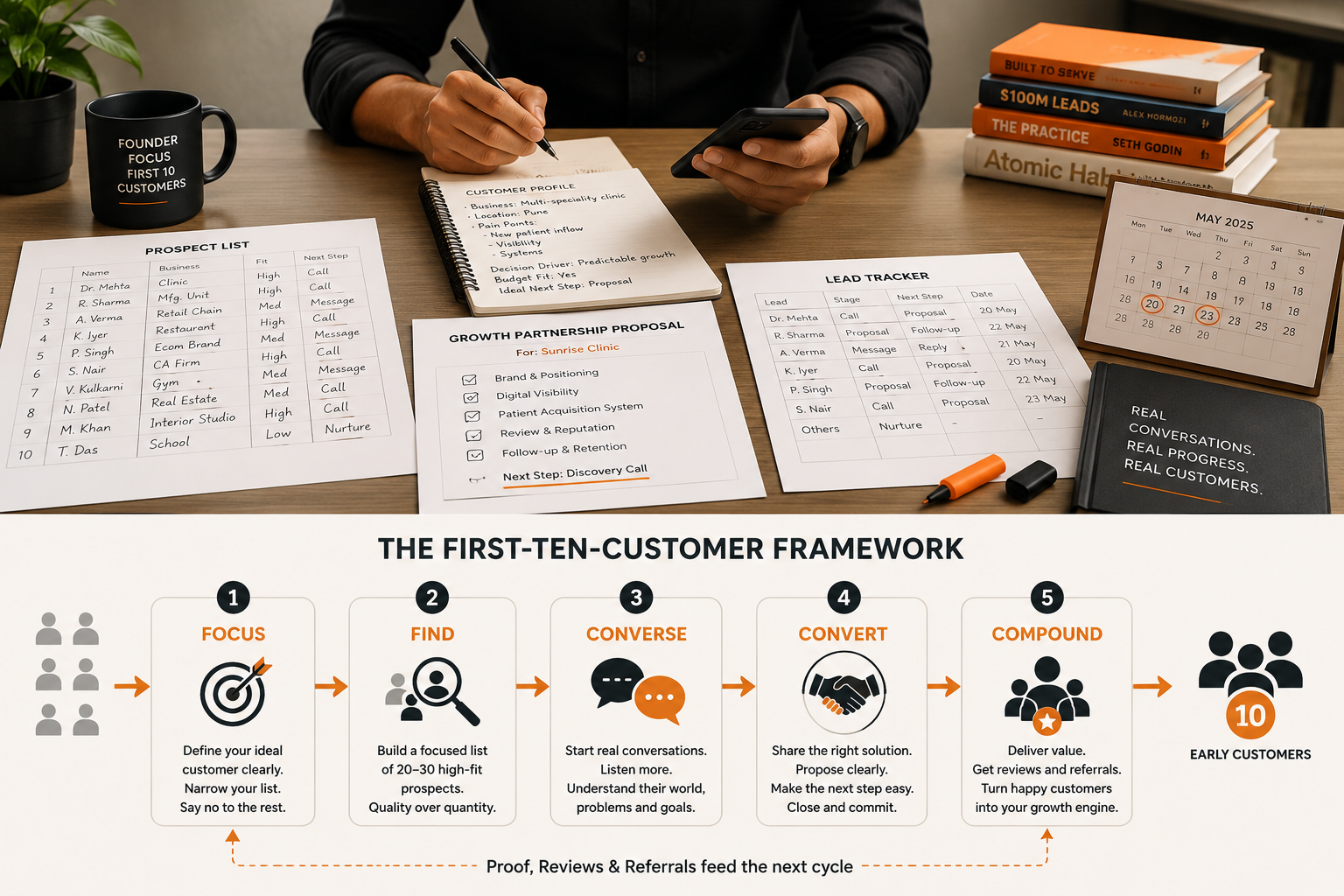
Use five stages:
Choose one primary customer group and one clear offer.
Your early message should not try to sell every service to every type of customer.
A focused offer makes it easier to:
Create a list of suitable potential customers.
Sources may include:
The objective is not to collect random contacts.
Each prospect should reasonably fit the customer profile.
Do not begin every interaction with a long sales pitch.
Start by understanding the customer’s current situation.
Ask:
A good conversation helps both sides evaluate fit.
Present a clear next step.
Depending on the business, it may be:
Make the decision understandable and proportionate to the customer’s current level of trust.
Every early customer should improve the ability to win the next one.
After successful delivery:
This creates a trust-building cycle.
Your first ten customers are unlikely to appear from ten conversations.
Build a larger, focused prospect list.
For each prospect, record:
Quality matters more than collecting thousands of contacts.
Begin with people who already know your work, character, or experience.
This may include:
Do not send a generic message asking everyone to buy.
Explain clearly:
For example:
I am working with owner-led clinics that want to improve Google visibility, reviews, and enquiry follow-up. Do you know a clinic owner who may be open to a short conversation about how they currently manage this?
This is easier to act on than:
Please refer anyone who needs digital marketing.
Direct outreach can work when it is relevant and respectful.
A useful message may include:
For example:
I noticed your showroom has strong customer feedback offline, but some service information is difficult to find online. I help owner-led local businesses improve how customers find, understand, and contact them. I have noted three practical improvements for your online presence. Would a short discussion be useful?
Do not pretend you have completed a detailed audit when you have not.
Avoid sending the same vague message to hundreds of people.
A new customer may not be ready to commit to a large project.
Create a smaller first step that allows the customer to evaluate your thinking and delivery.
Examples include:
The entry offer should still create genuine value.
It should not be meaningless work designed only to open the door.
Many founders follow up once and then stop.
Customers may be busy, uncertain, waiting for approval, or comparing alternatives.
A useful follow-up should add context.
You may:
Avoid repeatedly sending:
Any update?
Record the next date and purpose of the follow-up.
Early customers shape the future reputation of the business.
Set clear expectations regarding:
Do not promise extra work simply because you want to impress the customer.
Overdelivery without boundaries can create an unprofitable model and unrealistic expectations.
After completing the work, ask:
Never write the customer’s result for them without approval.
Use:
[ADD VERIFIED EXAMPLE]
where proof should be added before publication.
Do not ask:
Do you know anyone who needs my service?
Ask for a more specific introduction.
For example:
Do you know another clinic owner who receives regular enquiries but struggles with response and follow-up?
A specific referral request is easier to understand.
After every five or ten meaningful conversations, review:
Your first-customer process should become more focused over time.
Your network can provide:
Use your network for targeted access, not mass promotion.
For clinics, restaurants, gyms, retailers, showrooms, and professional services, local outreach can be effective.
Study the business before contacting it.
Look at:
Then begin with one relevant observation.
LinkedIn can help consultants, agencies, manufacturers, B2B services, and professional firms.
Use it to:
Do not depend only on posting content. Direct relationship-building is also important.
Find businesses that serve the same customer without directly competing.
Examples include:
A strong partner can provide customer access and borrowed trust.
A practical workshop can help the customer experience your expertise.
Possible topics include:
The workshop should solve a real problem, not become a long sales presentation.
Content can support early sales by demonstrating how you think.
Create content around:
Content alone may take time to generate customers. Combine it with direct outreach and conversations.
A new consultant could:
The audit creates a smaller entry point before a longer advisory engagement.
A new food business could:
The goal is not only to generate ten one-time orders. It is to learn which customers may order repeatedly.
A small manufacturer could:
The first ten customers may take longer because the buying cycle is more complex.
A provider helping clinics with online visibility could:
The provider should avoid making unverified claims about patient or revenue results.
A new product brand could:
Early purchases help validate the product, price, packaging, and customer experience.
A basic credible presence is useful.
But do not delay every customer conversation until the website is complete.
Broad outreach creates weak messages and mixed feedback.
Choose one primary customer group.
Free work may attract people who do not value or need the solution.
A paid pilot often provides stronger commercial evidence.
Customers can recognise mass outreach.
Personalise the reason for contact and focus on a relevant problem.
Early conversations are a source of market evidence.
Ask questions before presenting the complete solution.
A rejection does not always mean the price is wrong.
The problem may be customer fit, urgency, trust, scope, or communication.
A strong initial conversation can still be lost without a defined next step.
The first customers are the foundation of your proof and referral system.
Do not acquire more work than you can deliver properly.
The purpose of the month is not only to reach the number ten.
It is to create a repeatable process for winning suitable customers.
The time depends on the business, price, buying cycle, trust required, and founder’s access to customers.
A local low-cost offer may convert quickly. A specialised B2B service or manufacturing order may require several months of conversations and testing.
Paid ads may help when the customer, offer, message, and buying journey are already reasonably clear.
For many new businesses, direct conversations provide better early learning before large advertising investment.
A launch or pilot price can be appropriate when it reflects a limited scope, early version, or specific testing objective.
Explain the normal value and avoid creating an unsustainable long-term price.
They can, provided they genuinely need the offer and behave like real customers.
Do not treat supportive purchases as complete market validation.
Review:
Change one important factor at a time and test again.
The founder should usually understand the customer, offer, objections, and basic sales process before delegating sales completely.
A salesperson can support growth more effectively after the business has a clearer and repeatable process.
Learning how to get your first 10 customers is not about finding one perfect marketing trick.
It requires a disciplined process:
Your first customers help you build more than revenue.
They help you improve the offer, understand the market, strengthen your delivery, and create the trust required for future growth.
Do not wait for the business to look large.
Begin by becoming useful to a small number of the right customers.
.png)
.png)