

25 Aug 2026


Starting a business requires action under uncertainty.
You will not have complete information about the market, customer, pricing, competition, or future demand. Some decisions will need to be made before you feel fully prepared.
But uncertainty does not mean every decision should be based on instinct.
Many of the most common mistakes first-time founders make are avoidable. They happen when the founder confuses activity with progress, attention with demand, revenue with profit, or personal effort with a repeatable business.
A first-time founder may spend months building a website before speaking to customers. Another may generate enquiries without creating a follow-up process. Someone else may price the service too low, hire too early, or keep changing direction every few weeks.
These mistakes do not always destroy the business immediately.
They slowly create weak margins, customer confusion, founder exhaustion, and inconsistent execution.
The purpose of this article is not to make founders afraid of taking risks. It is to help them take better risks—with clearer assumptions, smaller tests, stronger financial discipline, and more attention to customer behaviour.
Most founders begin with strong energy but limited operating experience.
They may understand the product, profession, or industry but have less experience with:
The founder may also feel pressure to make the business look established quickly.
This creates visible activity:
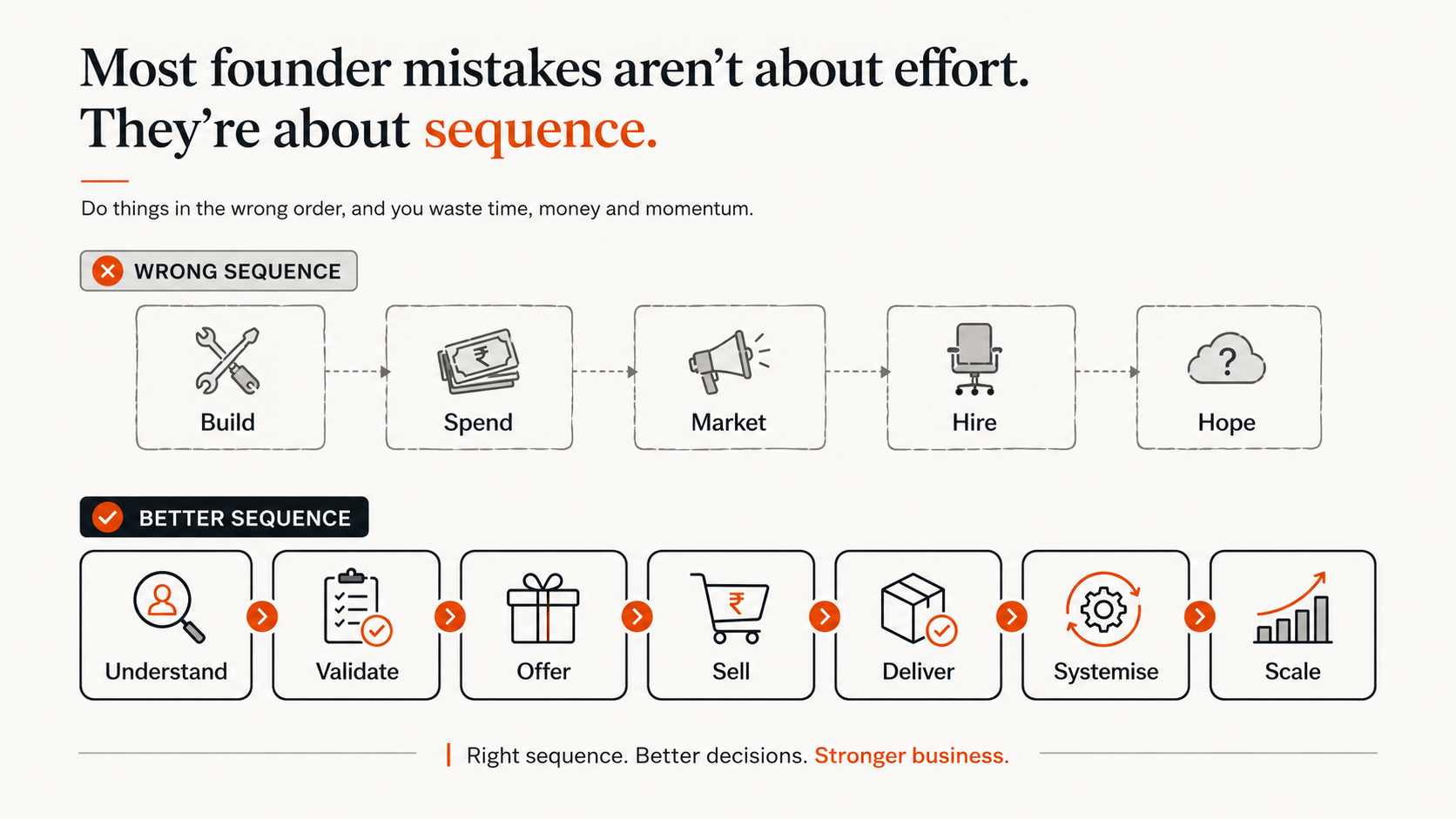
Some of these investments may be useful. The problem is the sequence.
A business should first clarify what customers need, what they will pay for, how the offer will be delivered, and whether the basic economics work.
Build evidence before building complexity.
One of the biggest mistakes is investing heavily before testing customer demand.
The founder may spend money on:
But none of these investments proves that customers will buy.
Validation means collecting evidence that a real customer has an important problem and is willing to take meaningful action.
That action may include:
Create the smallest version of the offer that can test the main assumption.
Speak to potential customers, present the offer, and look for behaviour rather than compliments.
New founders often fear that choosing a specific customer will reduce opportunity.
They use descriptions such as:
This creates weak marketing because different customers have different problems, budgets, decision processes, and trust requirements.
A restaurant, clinic, manufacturer, and consultant may all need marketing support, but they do not need the same offer.
Choose one primary customer group for the first stage.
Define:
Focus creates a starting point. It does not permanently limit the business.
A founder may become deeply attached to a product, feature, technology, or delivery method.
The conversation then becomes:
How do I convince customers to want this?
Instead of:
What are customers already trying to solve?
This is common in technology-led businesses, but it can happen in any industry.
A restaurant founder may be committed to a menu customers do not order. A consultant may keep selling a broad service nobody understands. A software founder may build features the user does not consider important.
Stay committed to solving the problem, but remain flexible about the solution.
Use customer feedback to adjust:
Changing the solution based on evidence is not a lack of vision. It is responsible execution.
A customer may understand the service category but still not understand what they are being asked to buy.
Offers such as “complete business growth,” “digital solutions,” or “premium consulting” are difficult to evaluate.
A clear offer should explain:
Package the first service or product around one specific problem.
For example:
A 30-day local visibility foundation for owner-led clinics, including Google profile improvement, review-request setup, website recommendations, and WhatsApp enquiry organisation.
The customer now has something concrete to assess.
First-time founders often underprice because they lack confidence or want to win every customer.
Others copy a competitor without understanding that competitor’s scope, costs, team, reputation, or business model.
Low pricing may create:
Calculate:
Then evaluate customer value, alternatives, scope, and positioning.
When a customer has a smaller budget, reduce the scope rather than delivering the complete service for an unsustainable price.
A business may generate sales and still struggle financially.
Revenue does not show:
A profitable sale on paper can still create cash-flow pressure when the customer pays after 60 days but employees and suppliers must be paid immediately.
Track at least:
Do not use revenue as the only measure of business health.
For financial, tax, and compliance decisions, consult qualified professionals using verified business information.
Marketing cannot repair an unclear business.
A founder may begin running advertisements while the business still has:
The campaign may create clicks or enquiries, but the rest of the customer journey loses them.
Before increasing marketing spend, review:
Marketing amplifies what already exists. Make sure it is amplifying clarity.
Some founders assume customers will buy once the website is live, social media content is published, or the product becomes available.
But customers may need:
Sales is not pressure. It is a structured process that helps suitable customers evaluate the offer.
Create a basic sales process:
More visibility does not automatically create better conversion.
A founder may hire because they feel overloaded.
But if the underlying process is unclear, the employee inherits confusion.
Problems include:
The founder then concludes that the employee is not capable.
The real problem may be the absence of role clarity and process.
Before hiring, define:
Hire for an identified responsibility, not only for general help.
In the early stage, the founder may remember every customer, quotation, payment, task, and promise.
As activity increases, information begins to disappear.
Common problems include:
Document simple repeatable processes.
Begin with:
A simple process that the team uses is better than a complex manual nobody follows.
Early customer interest can create pressure to add:
Expansion feels like growth, but it can also divide attention and increase costs.
A business should not scale a process it has not yet learned to deliver reliably.
Before expanding, check:
Strengthen the core before adding complexity.
Some founders make the opposite mistake.
They change the customer, offer, message, pricing, or marketing platform every few weeks.
Because several variables change together, they never learn what caused the result.
A campaign may be stopped before enough relevant customers see it. An offer may be changed after one rejection. A platform may be abandoned without reviewing the complete customer journey.
Run structured tests.
Define:
Stay flexible, but do not become random.
A clinic invests in social media advertisements before improving:
The campaign generates interest, but the operational process is not ready.
The better sequence is to improve trust, enquiry handling, and appointment communication before increasing promotion.
A restaurant launches with a large menu, expensive interiors, and several delivery platforms.
However, it has not tested:
A limited menu and controlled test may provide stronger evidence before a full-scale launch.
A small manufacturer accepts every customised order without defining:
Revenue increases, but complexity and rework reduce margins.
A clearer qualification and quotation process can protect production capacity.
A new consultant offers strategy, marketing, operations, sales, branding, and automation to every business.
Prospects struggle to understand the starting point.
A focused paid audit for one customer group can create a clearer entry offer, better proof, and a repeatable delivery process.
Review each area honestly.
Do not try to repair the entire business at once.
Find the mistake creating the greatest loss of time, money, or customer trust and correct that first.
Yes.
No founder begins with complete knowledge. The important question is whether mistakes are identified early, reviewed honestly, and converted into better decisions.
Investing heavily before validating the customer, problem, offer, and basic economics is one of the highest-risk mistakes.
It makes later changes more expensive.
No.
The business should have enough clarity to test responsibly, but it does not need to be perfect. Begin with a minimum useful offer and improve it through real customer evidence.
Track cash flow, control fixed costs, define payment terms, protect margins, collect receivables, and avoid expanding before the core model is stable.
Professional financial advice may be required for decisions specific to the business.
Hire when a clear, recurring responsibility exists and the business can define the expected result, process, authority, and cost of the role.
Operational numbers may need weekly review. Financial performance, marketing, sales conversion, customer feedback, and priorities should be reviewed at least monthly.
The review should lead to decisions, not only reports.
The most common mistakes first-time founders make usually come from doing the right activities in the wrong order.
They build before validating. Market before positioning. Hire before documenting. Expand before learning. Generate leads before creating follow-up. Focus on revenue before understanding cash flow.
A stronger sequence is:
You do not need to avoid every mistake.
You need to recognise mistakes quickly enough that they become lessons rather than permanent business habits.
Start with clarity. Build trust. Create systems. Execute consistently.
.png)
.png)