
25 Aug 2026

.png)
An offline business can be well-known in its neighbourhood and still appear invisible to a new customer.
The business may have years of experience, loyal customers, a strong product, and a reliable team. But when someone searches online, they may find incomplete information, outdated photographs, unanswered reviews, an inactive social media account, or no clear website.
That creates a gap between the real quality of the business and how the business appears online.
Building an online presence for an offline business is not about turning every business into an ecommerce company or social media brand.
It is about making sure customers can:
A customer may first hear about your business through a referral, notice your shop while travelling, find you through Google, see an Instagram post, or receive your number through WhatsApp.
Your online presence should support that journey.
An online presence is the complete collection of digital touchpoints through which customers discover, understand, evaluate, and contact your business.
It may include:
An online presence is not one platform.
A website alone is not enough if customers cannot find it. An Instagram account is not enough if customers cannot understand the services. A Google listing is not enough if the information is incomplete or the business does not respond to enquiries.
The different touchpoints need to work together.
An existing customer may already know your quality. A new customer does not.
Before visiting a clinic, restaurant, gym, showroom, coaching institute, or service provider, people often try to reduce uncertainty.
They may want to know:
When this information is missing, the customer may choose another business that is easier to evaluate.
This does not necessarily mean the competitor is better.
It may simply mean the competitor appears clearer and more trustworthy online.
Your online presence should represent the quality that already exists inside the business.
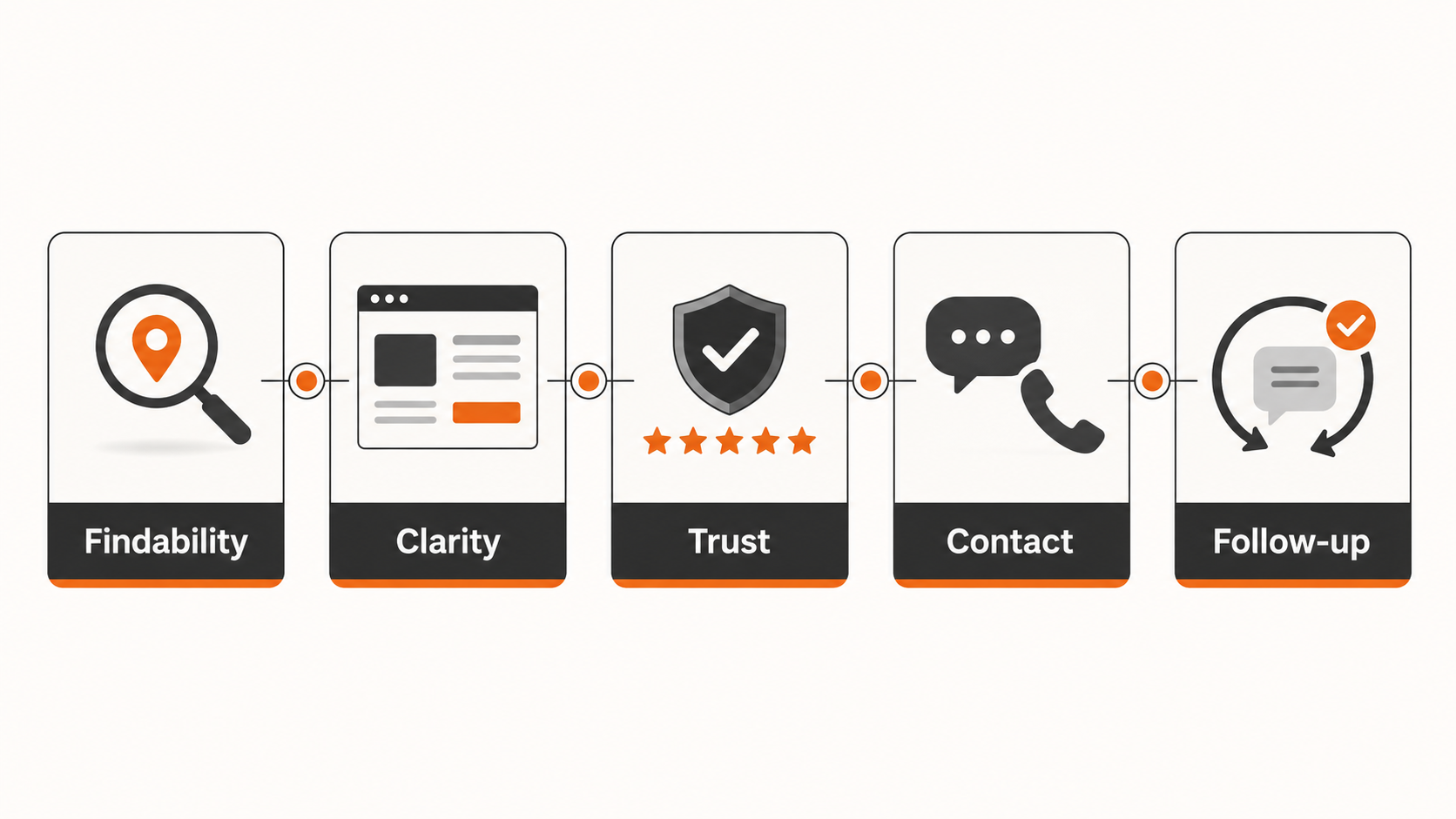
A useful online presence should perform five functions:
These five elements help connect online visibility with real business outcomes.
Can customers find your business when they search for:
For local businesses, this often begins with Google Business Profile, Google Maps, accurate listings, and location-focused website pages.
For manufacturers and B2B businesses, findability may depend more on search-friendly product pages, industry terms, directories, LinkedIn, and technical content.
Being online is not the same as being findable.
Once customers find you, can they quickly understand:
Avoid vague language such as:
Use clear customer language instead.
For example:
A physiotherapy clinic helping working professionals manage back, neck, and mobility problems through assessment-led treatment plans.
This gives the customer a clearer reason to continue.
Does your online presence provide enough evidence for a customer to believe you?
Trust can be supported by:
Only use proof that can be verified.
When stronger evidence is required, add:
Can an interested customer take the next step easily?
Depending on the business, the next step may be:
Do not make customers search for contact information.
Every important digital touchpoint should guide the customer towards one clear action.
What happens after a customer contacts the business?
An online presence creates value only when the business can handle the response.
A basic follow-up system should define:
Digital visibility without operational follow-up creates missed opportunities.
Before creating social media pages or rebuilding a website, clarify the business.
Write down:
Create a simple description:
We help [customer] with [problem or need] through [product, service, or approach].
For example:
We help homeowners create space-efficient custom furniture with clear design planning, production coordination, and installation support.
This message can guide your website, Google profile, WhatsApp description, social media bio, and sales communication.
For many local businesses, Google Business Profile is one of the most important online touchpoints.
Complete the profile with:
Check the listing regularly.
Update holiday timings, respond to customer questions, add current photographs, and correct inaccurate information.
Your Google profile should not look abandoned.
A small-business website does not need dozens of pages.
It needs to answer the customer’s important questions.
A practical website may include:
The home page should quickly communicate:
Avoid building a visually impressive website that leaves the customer confused.
Design should support clarity and trust.
Many Indian customers prefer WhatsApp because it feels direct and familiar.
But using a personal WhatsApp number without structure can create confusion.
WhatsApp Business can help organise:
Create quick replies for common questions, but keep the conversation human.
Customers should not feel trapped inside automated messages.
Use labels such as:
This creates a basic enquiry-management system.
Reviews help new customers understand the experience of previous customers.
Create a simple review process.
Ask for a review:
Do not ask customers to write false or exaggerated reviews.
You may guide them to mention useful details such as:
Respond professionally to both positive and negative reviews.
A defensive response can damage trust more than the original complaint.
You do not need to be active on every platform.
Choose platforms based on customer behaviour.
Select one or two channels you can manage consistently.
Use social media to show:
Do not post only festival greetings, generic quotes, and promotional posters.
Good business content begins with the questions customers already ask.
For example:
A clinic may create content about:
A furniture business may explain:
A manufacturer may publish:
Useful content helps customers evaluate the business before speaking to the team.
Ask every new lead:
How did you hear about us?
Record the answer.
Track sources such as:
Then record:
Without tracking, the business may continue investing in channels that create attention but few suitable customers.
A clinic’s online presence may include:
The objective is not to make exaggerated medical promises.
It is to reduce patient uncertainty and make appointment access easier.
A restaurant should make it easy for customers to check:
Instagram may create interest, while Google Maps, reviews, and accurate information help customers make the final decision.
A furniture business can use its online presence to show:
Customers may discover the business online and complete the purchase offline.
The role of digital content is to build enough interest and trust for the showroom visit.
A manufacturer may not need daily Instagram content.
A stronger online presence may include:
The online presence should help procurement teams and business buyers evaluate the company.
A gym can move beyond posting equipment photographs.
Its online presence may communicate:
The business should position itself around the customer’s desired transformation, not only membership access.
Opening accounts on every platform creates more maintenance without necessarily improving results.
Choose the channels that matter to the customer.
Different phone numbers, addresses, timings, or business names create confusion.
Keep information consistent across platforms.
A beautiful website cannot help if customers do not understand the business.
Clarity should guide design.
Every post does not need to sell, but content should support discovery, education, trust, or customer action.
Reviews are part of your public customer experience.
Respond professionally and use feedback to improve operations.
Social media platforms are useful, but your business should also build assets such as a website, customer database, reviews, and Google visibility.
Slow, incomplete, or inconsistent replies can waste all the effort used to generate attention.
Customers also want education, proof, processes, people, and practical information.
At the end of 30 days, review which touchpoints are generating customer action.
Not every business requires a complex website, but most established businesses benefit from having a digital space they control.
A website can explain services, present proof, answer questions, and guide customers towards an enquiry.
It can be a strong starting point, especially for local discovery.
However, a website, reviews, WhatsApp, and suitable social media channels can provide deeper information and build more trust.
The best platform depends on the customer and the nature of the business.
Visual consumer businesses may benefit from Instagram. B2B businesses may benefit from LinkedIn. Education-led businesses may benefit from YouTube.
Choose based on customer behaviour, not platform popularity.
Publish at a frequency the business can maintain without reducing quality.
One or two useful posts each week may be more effective than daily content with no clear purpose.
Basic profiles and communication systems can be improved within a few weeks.
Search visibility, reviews, content authority, and customer recognition usually require consistent work over time.
Yes.
Customers may discover the business online, evaluate it through reviews and content, contact it through WhatsApp, and complete the purchase or service offline.
The online and offline customer journey should support each other.
Building an online presence for an offline business does not mean being visible on every platform.
It means creating a connected digital system that helps the right customers find, understand, trust, and contact the business.
Begin with five areas:
Start with accurate information. Improve your Google presence. Build a clear website. Organise WhatsApp enquiries. Collect genuine reviews. Choose the right content channel. Track where customers come from.
Your offline reputation may already be strong.
The role of your online presence is to make that strength visible to customers who have not met you yet.
Visibility creates attention. Trust creates leads. Systems create scale. Execution creates results.
A strong online presence connects all four.
.png)
.png)