



marketing

When Should a Business Hire a Marketing Agency?

Blog Author Image
Dr.Atharv Kakade
CEO
30 Aug 2026
Single Blog Image

When Should a Business Hire a Marketing Agency?

Many founders reach a stage where they feel marketing has become too much to manage internally.

They may be handling:

  • Social media
  • Website updates
  • Google Business Profile
  • Ads
  • Content
  • Lead follow-up
  • Design
  • Campaign planning
  • Customer communication
  • Analytics
  • Agency conversations
  • Sales calls

At some point, the founder asks:

Should we hire a marketing agency?

The answer depends on the real problem.

A marketing agency can help when the business needs specialised execution, consistent campaigns, better content, improved visibility, stronger systems, or access to skills the internal team does not have.

But hiring an agency too early, too vaguely, or for the wrong problem can waste money.

A business should not hire an agency simply because:

  • Sales are slow
  • Competitors are posting more
  • The founder is busy
  • Ads did not work once
  • The website looks old
  • Someone promised quick leads
  • The business wants to “do marketing” without knowing the goal

Understanding when to hire a marketing agency helps founders avoid confusing activity with growth.

The right agency at the right time can be useful.

The wrong scope at the wrong time can add cost, confusion, and dependency.

Table of Contents

  1. What a marketing agency can and cannot do
  2. Signs your business may be ready for an agency
  3. When you should not hire an agency yet
  4. The seven-part agency readiness framework
  5. What to prepare before hiring an agency
  6. How to choose the right agency scope
  7. Examples by business type
  8. Common hiring mistakes
  9. Practical checklist
  10. Frequently asked questions
  11. Final takeaway

What a Marketing Agency Can and Cannot Do

What a Marketing Agency Can Help With

A good marketing agency may help with:

  • Strategy translation
  • Campaign execution
  • Content planning
  • Graphic design
  • Website improvement
  • SEO
  • Local SEO
  • Google Business Profile support
  • Social media management
  • Paid advertising
  • Lead-generation campaigns
  • Landing pages
  • Analytics and reporting
  • Email or WhatsApp campaign support
  • Brand communication

The agency can bring structure, skills, consistency, and execution capacity.

This is especially useful when the business knows what it wants to achieve but lacks time, team, or specialist knowledge.

What a Marketing Agency Cannot Fix Alone

An agency cannot fully solve problems such as:

  • Unclear business model
  • Weak offer
  • Poor customer experience
  • Bad product quality
  • Confusing pricing
  • No sales follow-up
  • Slow response
  • Founder indecision
  • Internal team misalignment
  • Unrealistic growth expectations
  • No budget discipline

Marketing can create attention.

But the business must be able to convert, deliver, and retain customers.

If the internal process is weak, more marketing may simply expose the weakness faster.

Signs Your Business May Be Ready for an Agency

You Have a Clear Offer

The business knows what it sells, who it serves, and why customers buy.

The agency does not need to guess the offer from scratch.

You Already Have Customer Understanding

You know:

  • Who your best customers are
  • Why they choose you
  • What objections they have
  • Which problems they want solved
  • Where they discover businesses like yours

This helps the agency create better campaigns.

You Have Proof

You have some genuine evidence such as:

  • Reviews
  • Testimonials
  • Product photographs
  • Project examples
  • Case studies
  • Customer feedback
  • Before-and-after examples
  • Certifications or qualifications where relevant

Proof helps marketing build trust.

You Can Respond to Leads

The business has a process for:

  • Answering calls
  • Replying to WhatsApp
  • Qualifying enquiries
  • Sending proposals
  • Following up
  • Tracking opportunities

Without this, lead-generation campaigns may produce noise instead of customers.

You Have a Realistic Budget

Marketing requires testing, learning, optimisation, and patience.

The budget should include:

  • Agency fee
  • Ad spend where relevant
  • Creative production
  • Website or landing-page improvements
  • Tools or software
  • Internal team time

Hiring an agency with an unrealistic budget often creates frustration for both sides.

You Have Internal Ownership

Someone inside the business must own decisions, approvals, feedback, and implementation.

An agency can support execution, but the business still needs an accountable internal owner.

You Know What Problem You Want Solved

For example:

  • We need better local visibility.
  • We need consistent content.
  • We need better lead generation.
  • We need to improve website conversion.
  • We need Google Ads managed properly.
  • We need our founder brand positioned clearly.
  • We need a customer journey and follow-up system.

Clear problems lead to better agency scopes.

When You Should Not Hire an Agency Yet

You Cannot Explain Your Business Clearly

If the founder cannot explain the customer, offer, pricing, and value, the agency will struggle to communicate it externally.

First clarify positioning.

Your Product or Service Is Not Ready

Marketing will not repair an offer customers do not value.

Validate the offer before scaling promotion.

You Have No Sales Process

If enquiries are not recorded, qualified, followed up, or reviewed, more leads may increase confusion.

Fix sales handling first.

You Want Guaranteed Instant Results

Marketing involves variables such as customer demand, competition, trust, offer strength, budget, channel, timing, and sales follow-up.

No responsible agency should promise guaranteed immediate sales without understanding the business.

You Want the Agency to “Do Everything”

This usually means the scope is unclear.

Marketing, sales, operations, and business strategy are connected, but responsibilities must be defined.

You Are Hiring Only Because a Competitor Is Active

Competitor activity can be a signal, but it should not be the full strategy.

Your marketing should match your customer, positioning, and business model.
‍

Single Blog Image

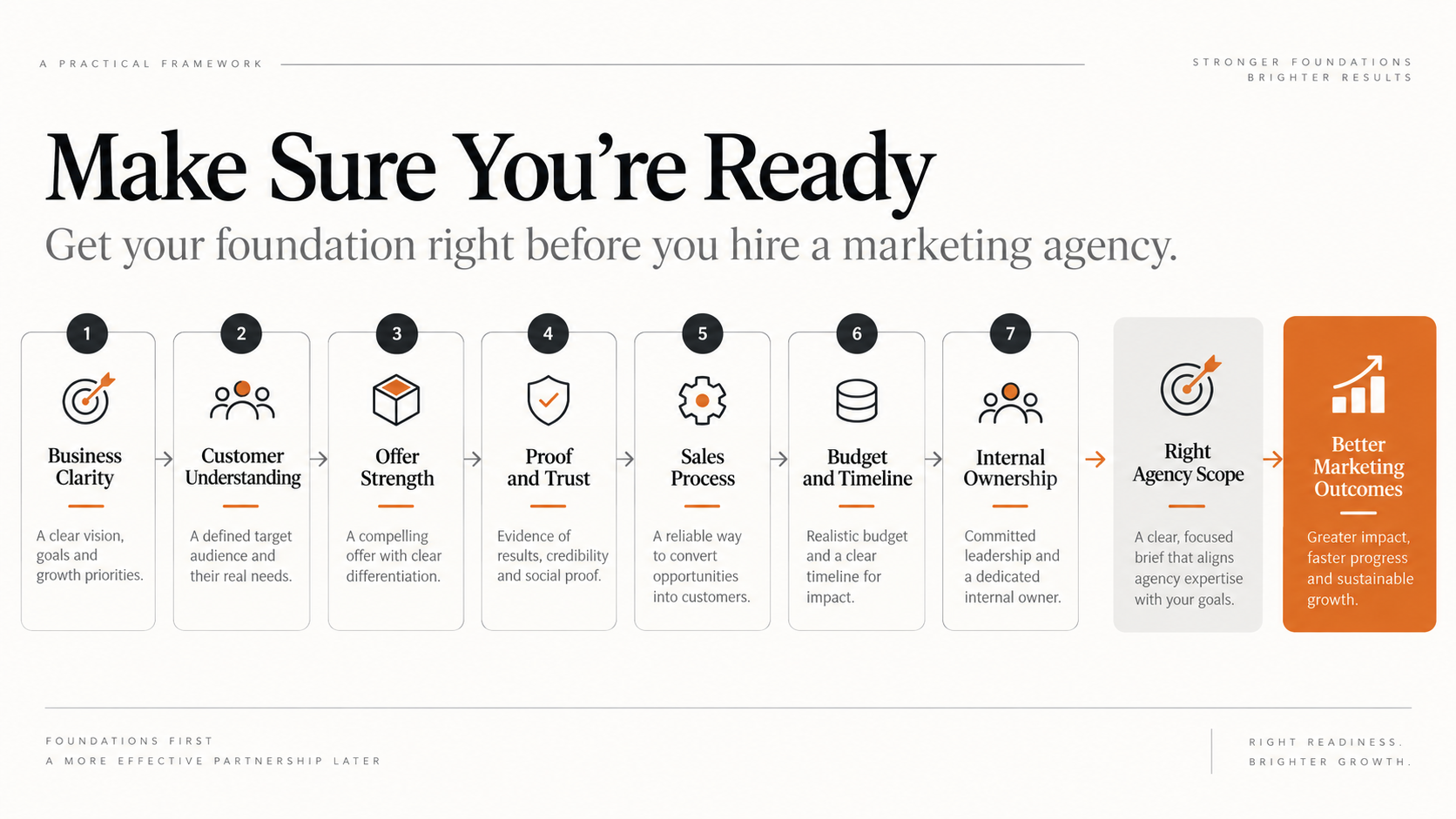
The Seven-Part Agency Readiness Framework

Use this framework before hiring.

1. Business Clarity

Can you clearly answer:

  • Who do we serve?
  • What do we sell?
  • What problem do we solve?
  • Why do customers choose us?
  • What is our main offer?
  • What is our pricing logic?

Without clarity, marketing becomes guesswork.

2. Customer Understanding

Do you know your customer’s:

  • Need
  • Buying concern
  • Search behaviour
  • Decision process
  • Objections
  • Preferred communication channel
  • Trust requirements

Marketing should be built around customer behaviour, not only founder preference.

3. Offer Strength

A strong offer is easy to understand and relevant to the customer.

It should communicate:

  • Who it is for
  • What is included
  • What problem it addresses
  • What outcome it supports
  • How the customer begins

A weak offer creates weak marketing.

4. Proof and Trust

The agency needs material that builds confidence.

Prepare:

  • Reviews
  • Testimonials
  • Founder profile
  • Product images
  • Project photographs
  • Process explanation
  • Customer stories
  • Certifications where applicable

Use only verified proof.

[ADD VERIFIED EXAMPLE]

5. Sales and Follow-Up Process

Marketing success depends on what happens after the enquiry.

Define:

  • Who responds
  • Response time
  • Qualification questions
  • Proposal process
  • Follow-up schedule
  • Lead tracker
  • Lost-lead reasons

An agency can generate opportunities, but the business must handle them properly.

6. Budget and Timeline

Decide what you can invest responsibly.

Also clarify whether the goal is:

  • Immediate enquiries
  • Brand awareness
  • Local visibility
  • Website improvement
  • Long-term SEO
  • Content authority
  • Founder positioning
  • Sales-system improvement

Different goals need different timelines.

7. Internal Ownership

Assign someone who will:

  • Approve content
  • Share business information
  • Review leads
  • Provide feedback
  • Track outcomes
  • Coordinate with the agency
  • Make timely decisions

Without internal ownership, even a capable agency will slow down.

What to Prepare Before Hiring a Marketing Agency

Business Overview

Prepare a simple document covering:

  • Business name
  • Location
  • Services or products
  • Target customers
  • Current channels
  • Main business goals
  • Current challenges
  • Competitors
  • Existing assets

Customer Information

Include:

  • Best customer types
  • Common objections
  • Customer FAQs
  • Past enquiry sources
  • Reasons customers buy
  • Reasons customers do not proceed

Existing Marketing Assets

Collect:

  • Logo
  • Brand colours
  • Photographs
  • Videos
  • Website links
  • Social accounts
  • Google Business Profile
  • Reviews
  • Brochures
  • Past ad creatives
  • Previous reports

Proof Library

Organise:

  • Testimonials
  • Case studies
  • Project photos
  • Customer messages with permission
  • Results that can be verified
  • Certifications
  • Founder credentials

Lead Handling Process

Document:

  • Where leads come from
  • Who responds
  • How quickly they respond
  • How enquiries are qualified
  • How quotations are sent
  • How follow-up happens
  • What tool tracks leads

This helps the agency understand whether the issue is visibility, conversion, sales, or operations.

How to Choose the Right Agency Scope

Do not hire an agency for “marketing” in general.

Choose the scope based on the business problem.

Local Visibility Scope

Useful for clinics, restaurants, salons, gyms, showrooms, and local services.

May include:

  • Google Business Profile
  • Local SEO
  • Reviews
  • Location pages
  • Local content
  • Website enquiry improvement

Content and Trust Scope

Useful when the business needs authority and customer education.

May include:

  • Content strategy
  • Social media
  • Blog articles
  • Founder content
  • Proof content
  • Testimonials
  • Case studies

Lead Generation Scope

Useful when the business has a strong offer and sales process.

May include:

  • Landing pages
  • Google Ads
  • Meta Ads
  • Lead forms
  • Campaign tracking
  • Follow-up integration

Website Conversion Scope

Useful when the business gets traffic but few enquiries.

May include:

  • Website audit
  • Service pages
  • CTAs
  • Proof placement
  • Forms
  • Speed and mobile checks
  • Analytics

Growth System Scope

Useful when marketing, sales, follow-up, and operations are disconnected.

May include:

  • Positioning
  • Customer journey
  • Lead tracking
  • WhatsApp setup
  • Sales follow-up
  • Content
  • Reporting
  • Team accountability

The right scope should match the actual bottleneck.

Examples by Business Type

Example 1: Doctor’s Clinic

A clinic may need an agency when:

  • Google profile is incomplete
  • Appointment enquiries are low
  • Reviews are not managed
  • Website content is unclear
  • Local visibility is weak

Before hiring, the clinic should verify qualifications, services, timings, appointment process, patient privacy requirements, and responsible communication rules.

Healthcare claims and marketing content should be reviewed appropriately.

[VERIFY BEFORE PUBLISHING]

Example 2: Restaurant

A restaurant may need support with:

  • Local visibility
  • Food photography
  • Menu presentation
  • Reviews
  • Group booking campaigns
  • Instagram content
  • Google Maps optimisation

But before advertising, it should ensure timings, menu, phone handling, reservation process, and service consistency are reliable.

Example 3: Manufacturer

A manufacturer should not hire an agency only to post generic social media content.

It may need:

  • B2B positioning
  • Technical website pages
  • Product category structure
  • Case studies
  • LinkedIn content
  • SEO
  • Enquiry forms
  • RFQ process improvement

The agency must understand technical buying journeys.

Example 4: Business Consultant

A consultant may hire an agency for:

  • Personal brand positioning
  • Thought-leadership content
  • Website improvement
  • Lead magnets
  • Audit offer page
  • Email or LinkedIn content
  • Funnel setup

But the consultant must first clarify the offer, audience, proof, and sales process.

Example 5: Furniture or Interior Business

An agency may help with:

  • Product photography
  • Instagram trust content
  • Google visibility
  • Website catalogue
  • Project case studies
  • Lead forms
  • Paid ads

Before scaling ads, the business should define how site visits, quotations, design approvals, and follow-ups are handled.

Common Mistakes When Hiring a Marketing Agency

Hiring Before Clarifying the Offer

The agency cannot market an unclear offer effectively.

Choosing Only Based on Price

A cheaper agency may become expensive if it creates poor strategy, weak content, or unqualified leads.

Expecting Marketing to Fix Delivery Problems

Bad customer experience will eventually damage reviews, referrals, and reputation.

Not Giving the Agency Enough Information

Agencies need business context, customer understanding, proof, and timely feedback.

Changing Direction Every Week

Constant changes prevent learning and consistency.

Measuring Only Likes and Followers

Track qualified enquiries, calls, bookings, sales conversations, quotations, and customers.

Ignoring Internal Follow-Up

A strong campaign can fail if nobody responds properly.

Signing a Vague Scope

Define deliverables, responsibilities, timelines, communication process, reporting, and decision ownership.

Asking for Guaranteed Sales

No agency can responsibly guarantee sales without controlling product, pricing, follow-up, competition, and customer behaviour.

Practical Agency Hiring Checklist

Business readiness

  • Is the offer clear?
  • Is the target customer defined?
  • Is the main problem identified?
  • Is pricing logic understood?

Proof

  • Do we have reviews?
  • Do we have real photographs?
  • Do we have customer examples?
  • Are all claims verified?

Sales process

  • Who handles leads?
  • How fast do we respond?
  • How do we qualify enquiries?
  • How do we follow up?
  • Where are leads tracked?

Scope

  • What exact problem should the agency solve?
  • Which channels are required?
  • What deliverables are expected?
  • What is outside the scope?
  • What timeline is realistic?

Budget

  • What is the agency fee?
  • What is the ad spend?
  • Are tools, production, and website changes included?
  • Can we sustain this for enough time to learn?

Ownership

  • Who approves work?
  • Who shares information?
  • Who reviews performance?
  • Who connects agency work to sales outcomes?

Questions to Ask Before Hiring an Agency

Ask:

  1. What problem are we hiring the agency to solve?
  2. What should success look like in 90 days?
  3. What business information will the agency need from us?
  4. Which channels are suitable for our customer?
  5. How will leads be tracked?
  6. How will enquiry quality be reviewed?
  7. What will the agency handle, and what must we handle internally?
  8. What proof, content, and assets do we need to provide?
  9. How often will performance be reviewed?
  10. What assumptions are we making?

These questions create a more responsible agency relationship.

Frequently Asked Questions

When should a small business hire a marketing agency?

A small business should consider hiring a marketing agency when it has a clear offer, defined customer, some customer proof, a basic sales process, realistic budget, and a specific marketing problem that needs specialist execution.

Should I hire an agency before launching my business?

Sometimes, but not always.

Before heavy marketing spend, validate the business idea, customer problem, offer, pricing, and first sales process.

An agency may help with research, positioning, launch assets, and early campaigns when the strategy is clear.

Can a marketing agency guarantee leads?

An agency may forecast or target lead generation, but responsible guarantees are difficult because results depend on offer, budget, competition, market demand, landing page, follow-up, and sales handling.

What is better: freelancer, in-house marketer, or agency?

It depends on the business need.

A freelancer may suit a specific task. An in-house marketer may suit daily coordination. An agency may suit multi-skill execution, campaigns, and strategic support.

How much should a business spend on marketing?

There is no fixed amount for every business.

Budget depends on goals, market, competition, revenue, margins, sales cycle, and channel selection.

Spend should be linked to a plan and measured responsibly.

How do I know if my agency is working?

Review more than activity.

Check whether the agency is improving visibility, enquiry quality, content clarity, customer trust, lead tracking, conversion support, and business learning.

Final Takeaway

Knowing when to hire a marketing agency can save a business from wasting money on disconnected activity.

Hire an agency when:

  1. Your business direction is clear
  2. Your customer is defined
  3. Your offer is understandable
  4. You have proof or can create it
  5. Your sales process can handle enquiries
  6. Your budget and timeline are realistic
  7. Someone internally owns the relationship

Do not hire an agency to avoid strategy.

Do not expect marketing to repair a weak offer, poor delivery, or missing sales process.

A good agency can accelerate execution when the foundation is ready.

Visibility creates attention. Trust creates leads. Sales systems convert opportunities. Strong operations retain customers. Execution creates results.

CTA

Request a Founder Growth Audit to identify whether your business needs marketing execution, positioning clarity, lead-process improvement, website conversion, content strategy, or a stronger growth system before hiring an agency.

‍